I've been experimenting with Windows Movie Maker recently. It's not a bad piece of software for something that's absolutely free if you are running a recent version of Windows. However it has a couple of major flaws that you need to be aware of concerning memory requirements and file paths.
First the memory problem. MovieMaker runs quite happily on a 32 bit system with 2GB of memory, until that is you get to the point of trying to publish a video in high definition. It simply runs out of memory. Increasing virtual memory seemed like it should solve the problem, but no, it had no effect. There seemed to be no other option for an immediate solution than moving the project to another machine with more memory. However that revealed another truth about Movie Maker. Its project file stores links to the various clips using absolute not relative paths.
Experimentation revealed that the paths weren't even stored relative to user home so for a truly portable project that would work on any PC, at least one that had a C drive, the only solution seemed to be to store the project in a folder with a fixed location that could easily be copied to another C drive on a different computer - unless anyone knows better!
Having finally fixed the problem, at least for a small test project, I could at last publish the video using the more capable computer. The spec was very similar apart from the fact that it has 4GB of memory. It's still running Win 7 32 bit so I'm reluctant to believe that the problem is anything other than that.
Problems solved or circumvented? Definitely circumvented. Let's hope Microsoft fix them in some future update and for now at least, advertise the fact that more than 2GB is required to run.
Wednesday, 11 December 2013

Monday, 13 August 2012
Looking back at London2012
Imagine is a song that evokes many memories of the past but after tonight's closing ceremony it will also be associated forever with London2012.
My best memories of the Olympics however include the amazement on Kate Copeland's face as it dawned on her that she and Sophie Hosking had won the gold medal in the lightweight double skulls, the sheer joy of Laura Trott on winning gold in the women's Omnium at the velodrome and Bradley Wiggins riding a lap of honour outside Hampton Court palace after the men's time trials as he sought out his family in the crowd.
By tomorrow no doubt the Olympic park will be all but deserted, but what a Games to look back on.

Congratulations to everyone who brought the dream to life and may the legacy live on!
My best memories of the Olympics however include the amazement on Kate Copeland's face as it dawned on her that she and Sophie Hosking had won the gold medal in the lightweight double skulls, the sheer joy of Laura Trott on winning gold in the women's Omnium at the velodrome and Bradley Wiggins riding a lap of honour outside Hampton Court palace after the men's time trials as he sought out his family in the crowd.
By tomorrow no doubt the Olympic park will be all but deserted, but what a Games to look back on.

Congratulations to everyone who brought the dream to life and may the legacy live on!
Sunday, 12 August 2012
Hats wigs and facepaint
The fact that Germany beat Netherlands 2-1 in the Men's Olympic Hockey final
yesterday has completely defeated my theory that the result was predetermined
by the proportion of spectators turning out in national colours. Take the
preliminary match I watched last week when Netherlands beat New Zealand. The
stands were a sea of orange. Synthetic orange wigs and brightly coloured
jackets were everywhere.

Supporters from the first match were still shouting Ozzie Ozzie Ozzie but black was nowhere to be seen other than on the pitch. The result? 5-1 to Netherlands. I was hopeful then when I saw plenty of red white and blue wigs as well as masses of facepaint in the union flag colours amongst the bronze medal match spectators yesterday. Sadly a result for TeamGB was not to be. Australia were the better team on the day winning 3-1. The green and gold hats, though definitely in the minority, were jubilant!

Supporters from the first match were still shouting Ozzie Ozzie Ozzie but black was nowhere to be seen other than on the pitch. The result? 5-1 to Netherlands. I was hopeful then when I saw plenty of red white and blue wigs as well as masses of facepaint in the union flag colours amongst the bronze medal match spectators yesterday. Sadly a result for TeamGB was not to be. Australia were the better team on the day winning 3-1. The green and gold hats, though definitely in the minority, were jubilant!
Netherlands 5 New Zealand 1
When I applied for tickets to the Olympics over a year ago it never occurred to me what an early start would be needed to get to the stadium by 8:30am. However the one pair of tickets I managed to get out of the ballot was to see the morning session of Hockey in the Olympic park itself and I wasn't about to turn down the opportunity. The feared security queues didn't materialize but it still took over 2 hours door to door from Surrey having left home a little before 6am.
By lunchtime we'd sat through 3 seasons of English weather, getting frozen, sunburnt and finally drenched, but we'd seen some superb hockey: Australia versus Argentina and New Zealand versus Netherlands.
 |
| Bakker scores to make it 3:1 |
By lunchtime we'd sat through 3 seasons of English weather, getting frozen, sunburnt and finally drenched, but we'd seen some superb hockey: Australia versus Argentina and New Zealand versus Netherlands.
Wednesday, 1 August 2012
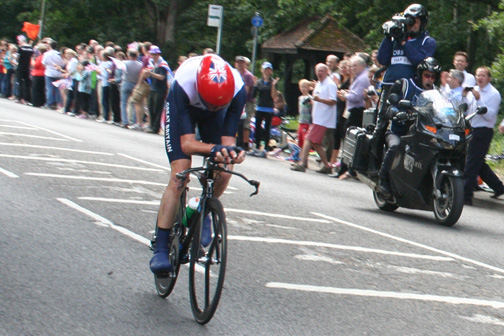
Wiggins Wins Gold
Can there ever have been so many people lining the streets of Surrey as for this week's Olympic cycling events?
 |
| Bradley Wiggins (Gold) |
Chris Froome and Bradley Wiggins were amongst the last few riders today and you could hear each of them approach by the roar going up from the crowd.
 |
| Chris Froome (Bronze) |
After the last competitor had passed I squeezed through the throng making their way on
foot or by bike back home or to cars parked all along the road leading
up to the A307. This quiet leafy lane was unrecognizable from its usual
mostly tranquil self. I made it in time to see the finish and see Bradley Wiggins and Chris Froome collect their gold and bronze medals respectively. What a day!
 |
| The dash home to see the finish |
Saturday, 28 July 2012
40 seconds from Gold
I watched the men's Olympic road race today and briefly glimpsed team GB as they raced through Oxshott, still leading the peloton.

Following the Torch
I've often whistled through the various stops en-route to Waterloo but on day 66 of the torch relay I found myself standing on the pavement not far from Earlsfield station, mingling with young families eagerly awaiting the torch's arrival. There was a carnival atmosphere as a steady procession of Samsung quad bikes, police motorcycles, the torch relay bus itself and a variety of open top buses belonging to various sponsors made its way South. There was waving of flags by those taking part in the procession, both in the street and on top of the buses.

Onlookers waved miniature flags and photographers from the world's TV
channels attempted to capture the sights with enormous camera
equipment. Their efforts may have been more professional but the
pictures from the onlookers will hold lasting memories.
Saturday, 21 July 2012
Ticket Machine Blues
Yesterday I missed my train. I could blame myself for not
leaving more time. I could blame my own meanness for not parking in the station
car-park, still charging a flat £5.30 at
3:30 in the afternoon when a town car park a 5 minute walk away charged £1 for
the two hours I needed. I could even blame my own stupidity for not realising
that the booking office was in fact open if I had entered the station from the opposite
side. Most of all though I blame the fact that the platform-side ticket machine
was in full sunlight. Its display could barely be read and the family in front
of me wasted all the time remaining repeatedly having to start again when they
pressed the wrong button. They gave up in the end but by that time it was too
late. I could see what the problem was instantly when I made the same mistake.
The button that appeared in the sunlight to be confirming the station selected
was in fact asking you if you wanted to depart from a different station. No
wonder they were confused.
Not only do ticket machines at out of town stations needed
to be located better, they also need to be more plentiful. At my nearest
station, not the one I used yesterday, there is only one, similarly sited with
the same problems in the afternoon sunshine. I could have bought my ticket in
advance and collected it from the machine but I'd still have had the same usability
problem. We live outside the Oyster card zone so using such ticket machines for
spur of the moment journeys is the only option when the booking office is
closed.
I first looked at the usability problem of forecourt ticket
machines a couple of years ago as part of a Human Computer interface project,
so I'd be the first to admit that creating a more usable interface is not an
easy task. Smartcard ticketing may be the answer but not everyone will opt for this. A redesign of the machines to incorporate a barcode reader to read a
mobile phone display so prepaid tickets could be collected with the press of
one button would have solved yesterday's problem though. Surely that can't be so difficult?
Thursday, 22 July 2010
Monitoring of web traffic on an online banking site. Risk or legitimate data collection?
LloydsTSB has redesigned its online banking service web site and I tried this out for the first time yesterday. The site, as well as displaying statements with the newest transaction at the top, claimed to have introduced new features which would make it easier for the user, but my own first impressions were far from favourable.
For a start there was a new quick payments page. They had provided a drop-down list of the recipients I had already set up. Paying one or more of these just entailed making a selection from the list and then choosing the amount and confirming the password as before. A link then enabled me to return to the same page to make another payment if I wished. Initially I assumed that this drop-down list had replaced the previous page of links and since it didn't include a reference number, though unhelpfully did include an 8 zero account number for credit card companies, I had an immediate problem as I had more than one account with the same institution. These had the same sort code and zeros account number. There was no way to distinguish between the two without the reference.
After a 10 minute wait on the online banking telephone helpline I was told that the old payments page could still be reached and I could make my payment there. This was true but there was no link back to it, so the process was going to take longer than before for multiple payments. This was supposed to be an improvement? Additionally the make payment and delete recipient buttons were very close together on different lines and I could see that deleting a recipient by mistake would be all too easy.
I've focused so far on usability, but a far more serious issue for me was the fact that the site momentarily redirected to statse.webtrendslive.com en-route to each new page. I eventually discovered that LloydsTSB are collecting marketing information in this way, but not until after I had wasted a considerable amount of time talking to technicians at an anti-virus software provider. They weren't knowledgeable enough and wanted to solve a non-existent virus problem with a sledge hammer approach. I'm always wary about researching viruses on the net as malicious sites can themselves introduce viruses whilst purporting to offer software to remove them. I did find discussions of webtrendslive on various forums though and once I had realised what was happening it was easy enough to block it using a Firefox add-on.
It's a shame that when asked, LloydsTSB's helpdesk staff only said that the presence of webtrendslive in the status bar was part of the workings of their website and didn't confess it was a 3rd party site. This kind of redirect is not what you expect in online banking and doesn't lead to confidence in the security of the site. When I also explained the usability problems the new site was causing, the helpdesk also didn't seem to think that an extra click to make multiple payments was an issue. "It's only one more click" they said. I suggested a new link would help, back to the payments page. It's a pity too that the choice of display order isn't set as a user preference as I'm sure not everyone will like this feature. The helpdesk promised to pass my comments on but I'll never know if they did. It would have been good to have been able to send the feedback to the right department. Someone there might have been more interested.
For a start there was a new quick payments page. They had provided a drop-down list of the recipients I had already set up. Paying one or more of these just entailed making a selection from the list and then choosing the amount and confirming the password as before. A link then enabled me to return to the same page to make another payment if I wished. Initially I assumed that this drop-down list had replaced the previous page of links and since it didn't include a reference number, though unhelpfully did include an 8 zero account number for credit card companies, I had an immediate problem as I had more than one account with the same institution. These had the same sort code and zeros account number. There was no way to distinguish between the two without the reference.
After a 10 minute wait on the online banking telephone helpline I was told that the old payments page could still be reached and I could make my payment there. This was true but there was no link back to it, so the process was going to take longer than before for multiple payments. This was supposed to be an improvement? Additionally the make payment and delete recipient buttons were very close together on different lines and I could see that deleting a recipient by mistake would be all too easy.
I've focused so far on usability, but a far more serious issue for me was the fact that the site momentarily redirected to statse.webtrendslive.com en-route to each new page. I eventually discovered that LloydsTSB are collecting marketing information in this way, but not until after I had wasted a considerable amount of time talking to technicians at an anti-virus software provider. They weren't knowledgeable enough and wanted to solve a non-existent virus problem with a sledge hammer approach. I'm always wary about researching viruses on the net as malicious sites can themselves introduce viruses whilst purporting to offer software to remove them. I did find discussions of webtrendslive on various forums though and once I had realised what was happening it was easy enough to block it using a Firefox add-on.
It's a shame that when asked, LloydsTSB's helpdesk staff only said that the presence of webtrendslive in the status bar was part of the workings of their website and didn't confess it was a 3rd party site. This kind of redirect is not what you expect in online banking and doesn't lead to confidence in the security of the site. When I also explained the usability problems the new site was causing, the helpdesk also didn't seem to think that an extra click to make multiple payments was an issue. "It's only one more click" they said. I suggested a new link would help, back to the payments page. It's a pity too that the choice of display order isn't set as a user preference as I'm sure not everyone will like this feature. The helpdesk promised to pass my comments on but I'll never know if they did. It would have been good to have been able to send the feedback to the right department. Someone there might have been more interested.
Thursday, 8 April 2010
Digital Economy Bill
I've tuned in to BBC Parliament on and off over the last two days to hear the debate on the Digital Economy Bill. I have to say I was surprised how few members were in the House on an issue of such importance. If many MPs didn't realise how important the issue was then that alone should tell us that the whole matter needed far more debate than the government chose to allow.
While the House appeared to contain at most around 40 MPs at various stages of the debate, and at times far fewer, according to Hansard, 236 of them eventually voted. My MP wasn't amongst them so it would appear that I wasted my time contacting him about my concerns over this issue.
Can we be sure that the nearly 200 MPs who weren't in the chamber throughout the debate were actually following this elsewhere? If they were sitting in an internet cafe somewhere perhaps it should have dawned on them that in a year's time they might actually have to join the ranks of those trying to look interested on the green benches in the Commons chamber in order to find out what was being said, or at the very least remain in the House for the entire evening. If they had the luxury of living near enough to spend the evening at home then I hope they won't have the misfortune to be one of those whose internet accounts are temporarily suspended at some time in the future. The legal costs of fighting such a suspension will be beyond the means of the vast majority of people.
While the House appeared to contain at most around 40 MPs at various stages of the debate, and at times far fewer, according to Hansard, 236 of them eventually voted. My MP wasn't amongst them so it would appear that I wasted my time contacting him about my concerns over this issue.
Can we be sure that the nearly 200 MPs who weren't in the chamber throughout the debate were actually following this elsewhere? If they were sitting in an internet cafe somewhere perhaps it should have dawned on them that in a year's time they might actually have to join the ranks of those trying to look interested on the green benches in the Commons chamber in order to find out what was being said, or at the very least remain in the House for the entire evening. If they had the luxury of living near enough to spend the evening at home then I hope they won't have the misfortune to be one of those whose internet accounts are temporarily suspended at some time in the future. The legal costs of fighting such a suspension will be beyond the means of the vast majority of people.
Sunday, 28 March 2010
To tag or not to tag
I'm probably somewhat behind in finally exploring the possibility of using tags as a way of organising my bookmarks. I was still using IE6 until a couple of weeks ago I finally succumbed to all the messages telling me my browser was in urgent need of replacement and installed IE8. At a stroke, finding the right sub-folder to put a link in became a real headache as Microsoft in their wisdom had "improved" favorites and it was no longer possible to collapse the folders.
OK, so those of you who've been living with this for a while have adapted somehow - or left to explore other browsers, but my journey had just begun. I began by submitting a support ticket to Microsoft. I was amazed at the level of service but the guy trying to help me was incredulous at the complexity of the folder system I had set up and he could see why I was having problems. His suggested workaround was never going to work for me. If I achieved nothing more than my concerns being passed on to the project team for IE9 perhaps I will have achieved something.
Perhaps it was time to move into the world of social bookmarking and explore the possibility of finding links using tags not folders, so my next venture was to sign up for del.icio.us and install the Delicious Bookmarks add-on in Firefox. It was at this point that I realised I had some 4000 links stored in folders about 3 deep. It soon became apparent that letting the add-on choose tags for all these links was a big mistake. Any tag I chose to search for brought up a myriad of sites that did not contain the one I wanted.
Tags may be a brilliant idea if you are starting from scratch but for anyone with an existing hierarchy of bookmarks that works well, perhaps they are better used independently for new links until the point where you find that the old folders have become redundant. I'm not even sure I like the most recent version of Firefox. Suddenly you have to click once to bookmark the link and then again to choose where to store it and how to tag it. Perhaps next week I'll explore another browser. For now I might even go back to IE6!
OK, so those of you who've been living with this for a while have adapted somehow - or left to explore other browsers, but my journey had just begun. I began by submitting a support ticket to Microsoft. I was amazed at the level of service but the guy trying to help me was incredulous at the complexity of the folder system I had set up and he could see why I was having problems. His suggested workaround was never going to work for me. If I achieved nothing more than my concerns being passed on to the project team for IE9 perhaps I will have achieved something.
Perhaps it was time to move into the world of social bookmarking and explore the possibility of finding links using tags not folders, so my next venture was to sign up for del.icio.us and install the Delicious Bookmarks add-on in Firefox. It was at this point that I realised I had some 4000 links stored in folders about 3 deep. It soon became apparent that letting the add-on choose tags for all these links was a big mistake. Any tag I chose to search for brought up a myriad of sites that did not contain the one I wanted.
Tags may be a brilliant idea if you are starting from scratch but for anyone with an existing hierarchy of bookmarks that works well, perhaps they are better used independently for new links until the point where you find that the old folders have become redundant. I'm not even sure I like the most recent version of Firefox. Suddenly you have to click once to bookmark the link and then again to choose where to store it and how to tag it. Perhaps next week I'll explore another browser. For now I might even go back to IE6!
Sunday, 1 November 2009
Help is 14 clicks away
An organisation whose website I visit frequently runs a helpdesk for computing problems. That's fairly usual in most organisations but what is somewhat surprising about this one is the fact that they keep their contact details such a well kept secret. I know their phone number; I have the page it's on bookmarked, but having heard others were having trouble finding it, I decided to see for myself just how hard it was to locate on the organisation's website.
Here's what I had to do:
One of the key usability principles of websites is that navigation through them should be made easy. It shouldn't be this hard to find details for a helpdesk and I would hope that any organisation that recognised itself in this real scenario would take steps to tackle the problem very quickly. Actually, long before step 14, I'd decided Google would have been quicker, but a real new user might well have given up. Do they have to make it so hard?
Here's what I had to do:
- Read a 1 page introduction.
- Read a 20 page guide. IT Support and Working with Computers is mentioned by page 11 but the helpdesk isn't mentioned until page 14, so a new user might not yet know it exists.
- Click the Getting help and support link mentioned in the guide.
- Click Computing Helpdesk.
- Click Computing Guide.
- Click Home. People new to the site may have trouble finding this. It doesn't explain where to find the ever so small link.
- Click the Support Tab.
- Scroll down; the Your Computer section is off the end of the page.
- Click Computing Guide
- Go back to Step 4 to find out where to go next - it isn't obvious.
- Return to Computing Guide, if I could still remember how.
- Click Getting Started.
- Click Computing Helpdesk.
- Click Contact Details - finally!
One of the key usability principles of websites is that navigation through them should be made easy. It shouldn't be this hard to find details for a helpdesk and I would hope that any organisation that recognised itself in this real scenario would take steps to tackle the problem very quickly. Actually, long before step 14, I'd decided Google would have been quicker, but a real new user might well have given up. Do they have to make it so hard?
Wednesday, 19 August 2009
Lost Networking
Am I the only person who thinks that a day out in London from the home counties using South West Trains has become extortionately expensive? It's not so long ago that a one day off-peak travel card from my area could be bought for around £8 and was usable on any train departing after 10am. Now it costs £14 for the same journey, though admittedly it would be a little cheaper after midday. Gone are the discounts that the Network rail card used to provide midweek as the minimum fare has been set at almost the price of the travelcard.
I wouldn't mind but for the fact that if I lived a short distance up the road I could travel anywhere I liked in Greater London for a day with an Oyster card for around £6 - £7, depending on which zone I started from and there are no silly super off- peak restrictions there. It would be tempting to jump in the car and do just that, but sadly the price of parking at the stations a few miles away is just as daft as my train fare.
You would think that government would impose some sanity on the situation to relieve congestion on local roads. If I spend the day in London shopping I am merely filling up an otherwise half empty train carriage. If I travel to somewhere like Bluewater or Lakeside round the M25 I'm adding to an already heavily congested motorway. In fact I didn't want to go shopping this week, but I might have spent a day being a tourist in central London. If I couldn't arrive until after midday at a sensible price there was little point.
I could of course buy a Network card just to use on Saturdays, but I probably wouldn't use it enough to justify its cost. It’s a pity though that South West Trains doesn't take into consideration the fact that a significant proportion of its customers have days off midweek rather than weekends and also that many are holidaying at home this year. This seems to be an opportunity lost to fill all those empty seats.
I wouldn't mind but for the fact that if I lived a short distance up the road I could travel anywhere I liked in Greater London for a day with an Oyster card for around £6 - £7, depending on which zone I started from and there are no silly super off- peak restrictions there. It would be tempting to jump in the car and do just that, but sadly the price of parking at the stations a few miles away is just as daft as my train fare.
You would think that government would impose some sanity on the situation to relieve congestion on local roads. If I spend the day in London shopping I am merely filling up an otherwise half empty train carriage. If I travel to somewhere like Bluewater or Lakeside round the M25 I'm adding to an already heavily congested motorway. In fact I didn't want to go shopping this week, but I might have spent a day being a tourist in central London. If I couldn't arrive until after midday at a sensible price there was little point.
I could of course buy a Network card just to use on Saturdays, but I probably wouldn't use it enough to justify its cost. It’s a pity though that South West Trains doesn't take into consideration the fact that a significant proportion of its customers have days off midweek rather than weekends and also that many are holidaying at home this year. This seems to be an opportunity lost to fill all those empty seats.
Sunday, 9 August 2009
Beyond Watford and back
I should have known better than to head North up the M1 on a Saturday in August. The world and his wife had clearly set out several hours before me and I was still trundling at 40mph or worse round the M25 at the point in time when I should have been rounding the corner to my final destination.
By Woburn, coffee was beckoning and I pulled in to the service area for a brief interlude. The car park was a sea of caravans, trailer tents and scout mini buses, bikers in leather and families with small kids eating ice creams, dad in shorts, the office already far away.
On the way back I must have encountered all those returning after last week's rain. I detoured through Watford and promptly joined the queue of cars waiting patiently for the football ground to disgorge its endless stream of fans, purposefully striding along, it seemed, in their yellow supporters' T-shirts. Whole families, kids in tow, teenagers, best mates, they were all there. As I passed on through Northwood and Ruislip, an occasional pair were exquisitely dressed with boutique carriers in hand, back from a day out in the West End perhaps. Others, more nondescriptly attired, were struggling home from the weekly shop and there were teenagers let loose for the holidays, more interested in their friends, maybe, than where they were heading.
I wonder how many of the people crawling round London's outskirts would have gone by train if our transport system were more integrated. I remember travelling to Toronto in the 70s and being amazed that interchange stations for city buses were undercover and warm. You could hop on and off buses as many times as you liked before the expiry time of your ticket. Thirty years later, even central London doesn't match that kind of experience, though the Oyster card has improved life for regular travellers. Anyone with more than a light suitcase to carry is still distinctly unwelcome though, as steep steps sometimes form impenetrable barriers with not a lift or escalator in sight. The M25 carries cars, but why wasn't it built with a railway alongside, linking effectively with frequent bus and train services from en-route stations, along spokes leading in and out of the city and to airports?
I actually enjoyed my return journey yesterday. Its slow pace provided a fascinating diversion as I stopped at countless sets of traffic lights, watching the melée of people making their way home after a Saturday out. As a mere onlooker though, I was all too aware that I added to congestion on streets where I didn't need to be.
By Woburn, coffee was beckoning and I pulled in to the service area for a brief interlude. The car park was a sea of caravans, trailer tents and scout mini buses, bikers in leather and families with small kids eating ice creams, dad in shorts, the office already far away.
On the way back I must have encountered all those returning after last week's rain. I detoured through Watford and promptly joined the queue of cars waiting patiently for the football ground to disgorge its endless stream of fans, purposefully striding along, it seemed, in their yellow supporters' T-shirts. Whole families, kids in tow, teenagers, best mates, they were all there. As I passed on through Northwood and Ruislip, an occasional pair were exquisitely dressed with boutique carriers in hand, back from a day out in the West End perhaps. Others, more nondescriptly attired, were struggling home from the weekly shop and there were teenagers let loose for the holidays, more interested in their friends, maybe, than where they were heading.
I wonder how many of the people crawling round London's outskirts would have gone by train if our transport system were more integrated. I remember travelling to Toronto in the 70s and being amazed that interchange stations for city buses were undercover and warm. You could hop on and off buses as many times as you liked before the expiry time of your ticket. Thirty years later, even central London doesn't match that kind of experience, though the Oyster card has improved life for regular travellers. Anyone with more than a light suitcase to carry is still distinctly unwelcome though, as steep steps sometimes form impenetrable barriers with not a lift or escalator in sight. The M25 carries cars, but why wasn't it built with a railway alongside, linking effectively with frequent bus and train services from en-route stations, along spokes leading in and out of the city and to airports?
I actually enjoyed my return journey yesterday. Its slow pace provided a fascinating diversion as I stopped at countless sets of traffic lights, watching the melée of people making their way home after a Saturday out. As a mere onlooker though, I was all too aware that I added to congestion on streets where I didn't need to be.
Thursday, 6 August 2009
Call centre blues
I wonder whether automated switchboards and call centres really save companies money. They certainly don't help the consumer.
Take the last couple of week as an example. I've several times had to start again with an automated switchboard, as the option I needed wasn't there and neither was there an option to speak to an adviser. I've spoken to call centre operators in India. They recited the questions on their crib sheets in perfect English. It's sad that they didn't have enough practice in understanding English accents to distinguish between different digits comprising a phone number, let alone our sometimes unfortunately pronounced place names. On the first two occasions, promised confirmations never appeared. I wasn't confident that the resulting promise of action was going to yield the required result so a confirmation seemed essential. When it finally arrived it was in the form of a somewhat ambiguous email, so I started the whole process over again. I now live in hopes that a final conversation with someone actually in the UK was informed enough that I should stop worrying.
I really don't understand the philosophy of outsourcing jobs to other countries in a time of recession, but it might just work if staff there were given enough training. They know how to do their jobs, but without lengthy stays in England they aren't going to understand British colloquialisms, let alone some of our quirkier regional accents. On automated exchanges I have even less patience. This recent experience has cost me upwards of an hour of my time and has resulted in me tying up the call centre operatives of the company I'm dealing with on multiple occasions, when once should have been enough.
My plea to all companies considering outsourcing would be to remember that a basic grasp of speaking English isn't sufficient and will waste your staff's productivity as well as annoying your customers. As for automated exchanges, you need to test these with a much wider range of scenarios and ensure that the poor customer does not have to wade through half a dozen levels only to fail at the final hurdle.
Take the last couple of week as an example. I've several times had to start again with an automated switchboard, as the option I needed wasn't there and neither was there an option to speak to an adviser. I've spoken to call centre operators in India. They recited the questions on their crib sheets in perfect English. It's sad that they didn't have enough practice in understanding English accents to distinguish between different digits comprising a phone number, let alone our sometimes unfortunately pronounced place names. On the first two occasions, promised confirmations never appeared. I wasn't confident that the resulting promise of action was going to yield the required result so a confirmation seemed essential. When it finally arrived it was in the form of a somewhat ambiguous email, so I started the whole process over again. I now live in hopes that a final conversation with someone actually in the UK was informed enough that I should stop worrying.
I really don't understand the philosophy of outsourcing jobs to other countries in a time of recession, but it might just work if staff there were given enough training. They know how to do their jobs, but without lengthy stays in England they aren't going to understand British colloquialisms, let alone some of our quirkier regional accents. On automated exchanges I have even less patience. This recent experience has cost me upwards of an hour of my time and has resulted in me tying up the call centre operatives of the company I'm dealing with on multiple occasions, when once should have been enough.
My plea to all companies considering outsourcing would be to remember that a basic grasp of speaking English isn't sufficient and will waste your staff's productivity as well as annoying your customers. As for automated exchanges, you need to test these with a much wider range of scenarios and ensure that the poor customer does not have to wade through half a dozen levels only to fail at the final hurdle.
Sunday, 2 August 2009
A Conversation with Martin Bean
The Open University's vice chancellor designate, Martin Bean, doesn't take up his new appointment until October this year but he's reportedly in the UK in August with a busy familiarisation schedule. No doubt Martin will be intent on finding out more of what happens at Walton Hall, the Open University's Buckinghamshire headquarters. I'm sure he is already well versed in the structure of this very unique university and its diverse workforce. He may well have some misconceptions to overcome at first though. Here's how an interview with Martin might go after one of his visits.
So Martin, how are you finding Walton Hall?
Great thanks. There's a terrific buzz here with all these lofty academics everywhere. One thing's puzzling me though.
What's that Martin?
Well I understand there are some 8000 associate lecturers working for the OU but I can't seem to find out where they are. Do you know where the AL wing is?
Oh that's an easy one to answer, Martin. There isn't one. They all work at home!
That explains it then. Lucky them! Perhaps I'd better arrange some tele-conferencing sessions to talk to some of them then. Do you know what sort of equipment the OU buys for them?
Actually the OU doesn't supply them with any equipment Martin. They have to buy their own.
But surely we insist they spend their ICT allowance on standardised equipment and arrange preferred suppliers, that sort of thing?
Actually Martin, the ICT allowance doesn't cover much more than a few ink cartridges and the odd ream of paper let alone a new PC every few years.
You'll be telling me they have to pay tax on the allowance next!
Well actually Martin, yes they do. It's been amalgamated into the pay-rates.
But these are quite generous aren't they? I understood an AL working full time could earn over £31,000? That's not bad if they can swan off to the golf club whenever they choose.
But they don't actually earn anything like that Martin. For a start, they're only allowed to work on the equivalent of 6 30 point courses even if they don't work anywhere else as well, though of course they may not tutor that many.
So if they work on 6 30 point courses we consider them full time and pay them £31,000?
No Martin, it doesn't quite work like that. For example, we say they can do the job for a typical second level course in about 3 hours a week, which works out at 5.75% of their time annually for each course - that's 34% if they tutored 6 courses.
I'm starting to think I'd like to be an AL here! You mean we pay them over £31,000 and they only work for 34% of their time?
No Martin, those hours don't bear any relation to the hours it would actually take to do the job. We've never calculated that - these were just guesses we put together last time they complained. It made it look as if we'd put some thought into the negotiations.
So how long would it take to do the marking ALs do? I heard assignments were supposed to take about 45 minutes to mark . That can't add up to much. Besides they all have detailed mark schemes don't they, so there's no real thought involved is there?
I don't know where you got that idea from Martin. Assignments can take hours to mark. Each one has to have loads of personalised feedback as well as a mark. You'd have to know the course inside out to do it. It's a really difficult job.
But apart from that, ALs only have to run a few tutorials, and we supply all the materials they need for that don't we?
Well no actually. Most of them write all their own tutorial materials.
But that's their choice surely?
No Martin, they have to write them because we don't supply any for many courses.
But they're paid for that!
Well yes and no Martin. I suppose the 3 hours a week we say they need to work might cover some tutorial preparation, but it doesn't cover the time they need to read the course units.
Why are we employing these people if they need to read the course units? Surely they're supposed to be experts?
They are Martin. They can read the units in a fraction of the time it would take a student, but they still need to read them to find out what a student is supposed to know. They can't help them otherwise.
But we pay them a fee to read the materials thoroughly when we first start a new course don't we?
No Martin. I think we used to, but we don't any more.
Well can't they do all this reading between course presentations? After all we pay them for 52 weeks a year don't we?
We certainly assume they work 52 weeks a year when we calculate their pay fractions. That's a bit embarrassing actually. Everyone else in the university gets 30 to 33 days holiday, 3 university closure days and bank holidays. AL pay assumes no holidays and no compensation for unsociable hours working either.
But they get a generous amount of time off for scholarship don't they? I see we have an excellent fee waiver scheme as well as regional staff development days.
We don't charge them for any of this Martin, but it happens in their own time. That's another embarrassing point. Even our regional academics can have 2 months paid study leave in each 2 years worked. That's half what a central academic would get, but in line with the 10% offered by other universities for such staff. Our ALs get none. We don't even pay them to attend any conferences or meetings we want them to be at.
So you're saying the job can't be done in the time we've stated then. Have you any idea what factor we're understating it by?
I 'd estimate about 2.3 Martin, but it could be higher.
You mean if we upped the 3 hours by 2.3% it'd be about right? Phew, that's not much. I thought you were talking about a much larger figure for a moment!
I was Martin. I meant you'd have to multiply the figure by about 2.3 to get a more realistic workload estimate.
You mean we'd have to pay them over £71,000 p.a.?
No Martin, they'd still only be earning about £27,000 if they taught 6 of those 30 point courses.
You mean they're not even earning that now?
No Martin. They'd get paid about £12,000 for that using the calculations we use right now.
That's scandalous. Why don't they all resign?
I think they would Martin, but in this climate…….
[Note that the conversation above is entirely fictitious]
So Martin, how are you finding Walton Hall?
Great thanks. There's a terrific buzz here with all these lofty academics everywhere. One thing's puzzling me though.
What's that Martin?
Well I understand there are some 8000 associate lecturers working for the OU but I can't seem to find out where they are. Do you know where the AL wing is?
Oh that's an easy one to answer, Martin. There isn't one. They all work at home!
That explains it then. Lucky them! Perhaps I'd better arrange some tele-conferencing sessions to talk to some of them then. Do you know what sort of equipment the OU buys for them?
Actually the OU doesn't supply them with any equipment Martin. They have to buy their own.
But surely we insist they spend their ICT allowance on standardised equipment and arrange preferred suppliers, that sort of thing?
Actually Martin, the ICT allowance doesn't cover much more than a few ink cartridges and the odd ream of paper let alone a new PC every few years.
You'll be telling me they have to pay tax on the allowance next!
Well actually Martin, yes they do. It's been amalgamated into the pay-rates.
But these are quite generous aren't they? I understood an AL working full time could earn over £31,000? That's not bad if they can swan off to the golf club whenever they choose.
But they don't actually earn anything like that Martin. For a start, they're only allowed to work on the equivalent of 6 30 point courses even if they don't work anywhere else as well, though of course they may not tutor that many.
So if they work on 6 30 point courses we consider them full time and pay them £31,000?
No Martin, it doesn't quite work like that. For example, we say they can do the job for a typical second level course in about 3 hours a week, which works out at 5.75% of their time annually for each course - that's 34% if they tutored 6 courses.
I'm starting to think I'd like to be an AL here! You mean we pay them over £31,000 and they only work for 34% of their time?
No Martin, those hours don't bear any relation to the hours it would actually take to do the job. We've never calculated that - these were just guesses we put together last time they complained. It made it look as if we'd put some thought into the negotiations.
So how long would it take to do the marking ALs do? I heard assignments were supposed to take about 45 minutes to mark . That can't add up to much. Besides they all have detailed mark schemes don't they, so there's no real thought involved is there?
I don't know where you got that idea from Martin. Assignments can take hours to mark. Each one has to have loads of personalised feedback as well as a mark. You'd have to know the course inside out to do it. It's a really difficult job.
But apart from that, ALs only have to run a few tutorials, and we supply all the materials they need for that don't we?
Well no actually. Most of them write all their own tutorial materials.
But that's their choice surely?
No Martin, they have to write them because we don't supply any for many courses.
But they're paid for that!
Well yes and no Martin. I suppose the 3 hours a week we say they need to work might cover some tutorial preparation, but it doesn't cover the time they need to read the course units.
Why are we employing these people if they need to read the course units? Surely they're supposed to be experts?
They are Martin. They can read the units in a fraction of the time it would take a student, but they still need to read them to find out what a student is supposed to know. They can't help them otherwise.
But we pay them a fee to read the materials thoroughly when we first start a new course don't we?
No Martin. I think we used to, but we don't any more.
Well can't they do all this reading between course presentations? After all we pay them for 52 weeks a year don't we?
We certainly assume they work 52 weeks a year when we calculate their pay fractions. That's a bit embarrassing actually. Everyone else in the university gets 30 to 33 days holiday, 3 university closure days and bank holidays. AL pay assumes no holidays and no compensation for unsociable hours working either.
But they get a generous amount of time off for scholarship don't they? I see we have an excellent fee waiver scheme as well as regional staff development days.
We don't charge them for any of this Martin, but it happens in their own time. That's another embarrassing point. Even our regional academics can have 2 months paid study leave in each 2 years worked. That's half what a central academic would get, but in line with the 10% offered by other universities for such staff. Our ALs get none. We don't even pay them to attend any conferences or meetings we want them to be at.
So you're saying the job can't be done in the time we've stated then. Have you any idea what factor we're understating it by?
I 'd estimate about 2.3 Martin, but it could be higher.
You mean if we upped the 3 hours by 2.3% it'd be about right? Phew, that's not much. I thought you were talking about a much larger figure for a moment!
I was Martin. I meant you'd have to multiply the figure by about 2.3 to get a more realistic workload estimate.
You mean we'd have to pay them over £71,000 p.a.?
No Martin, they'd still only be earning about £27,000 if they taught 6 of those 30 point courses.
You mean they're not even earning that now?
No Martin. They'd get paid about £12,000 for that using the calculations we use right now.
That's scandalous. Why don't they all resign?
I think they would Martin, but in this climate…….
[Note that the conversation above is entirely fictitious]
Tuesday, 14 July 2009
Indian Spice
I was in India last week. I knew Delhi had recently built a metro system. I knew many IT and call centre jobs had been exported to India. I knew that the car manufacturer Tata had its headquarters in Mumbai and now owned Jaguar Land Rover. Delhi, where I was based, is said [1] to be the 3rd wealthiest town in India, so I expected to find a modern cosmopolitan city centre. The trappings of any large city centre are there: the plush hotels, embassies, hospitals and banks. The malls are there too, though are harder to find, but you won't see huge department stores lining the streets. In Connaught Place, in the centre of New Delhi, there's a huge green space surrounded by businesses, local souvenir shops and stalls, and there's an underground bazaar. It's hard to shop at all without being accosted by locals, often students, eager to practise their English and guide you to where they think you should go, usually to the information office or the government emporium not far away.
What quite took my breath away was the traffic on the streets. Delhi itself is full, not of private cars, but of ancient taxis, many of them the three wheeler variety, as well as mopeds, bicycles, fully laden buses, delivery carts and lorries. I would not like to have driven in India; driving is by accelerator and horn. When three lanes merge into two it's every man for himself. As you travel farther out from the city through small towns and villages, the traffic hardly abates, but is joined by bullock drawn carts and tricycles laden sky high with everything from sacks of produce to building materials. Workers are driven to and from their jobs in lorries and people standing clinging to the rear were not an uncommon sight. The three wheeler taxis, though equipped to carry only two adults in relative comfort, were often filled with a family of six and occasionally people were even sitting on the roof of these canvas topped carriers.
The monsoon had not yet come and the streets were hot and dusty. In the early morning it was not obvious what was behind the dingy pull down shutters on every shop front. Later in the day, the variety of trades and small businesses they hid became apparent, though produce was just as likely to be sold from a handcart in the street. Beggars plied their trade at every crossing and the occasional cow could be seen wandering beside the road, as, of course, they are sacred there. Small shacks with flat roofs lined the approaches. If there was any wealth there it was well hidden. In between villages the fields were parched and water courses virtually empty. There was the occasional cluster of traditional straw huts and when we passed back the same way in the evening, animals could be seen tethered outside.
India is not all poverty though. Fellow travellers on a train, on which I had managed to book e-tickets before leaving England, were Indian businessmen, with their laptops and mobile phones. The Ajmer Shatabdi Express was not particularly fast, but my carriage, though having the appearance of one built many years ago, was well equipped with power sockets, air conditioning, comfy airline type seats and capacious overhead racks. Admittedly this was not the crowded 3rd class carriage of some of the slower trains. The metro too carried a diverse range of people but it was clear that India has a far greater social divide than we experience here in the West.
I cannot but describe this as an amazing week. I set out to visit some of the world's most famous tourist sites. My itinerary included the Taj Mahal at Agra and the pink city of Jaipur and its observatory. I will take away many beautiful images of these, but no one could visit this part of India without being overawed by the rich tapestry that is the bustle of daily life there mingled with the scents of Indian spices, and a people jostling with each other to eke out a living.
[1] http://www.mapsofindia.com/top-ten-cities-of-india/top-ten-wealthiest-towns-india.html
What quite took my breath away was the traffic on the streets. Delhi itself is full, not of private cars, but of ancient taxis, many of them the three wheeler variety, as well as mopeds, bicycles, fully laden buses, delivery carts and lorries. I would not like to have driven in India; driving is by accelerator and horn. When three lanes merge into two it's every man for himself. As you travel farther out from the city through small towns and villages, the traffic hardly abates, but is joined by bullock drawn carts and tricycles laden sky high with everything from sacks of produce to building materials. Workers are driven to and from their jobs in lorries and people standing clinging to the rear were not an uncommon sight. The three wheeler taxis, though equipped to carry only two adults in relative comfort, were often filled with a family of six and occasionally people were even sitting on the roof of these canvas topped carriers.
The monsoon had not yet come and the streets were hot and dusty. In the early morning it was not obvious what was behind the dingy pull down shutters on every shop front. Later in the day, the variety of trades and small businesses they hid became apparent, though produce was just as likely to be sold from a handcart in the street. Beggars plied their trade at every crossing and the occasional cow could be seen wandering beside the road, as, of course, they are sacred there. Small shacks with flat roofs lined the approaches. If there was any wealth there it was well hidden. In between villages the fields were parched and water courses virtually empty. There was the occasional cluster of traditional straw huts and when we passed back the same way in the evening, animals could be seen tethered outside.
India is not all poverty though. Fellow travellers on a train, on which I had managed to book e-tickets before leaving England, were Indian businessmen, with their laptops and mobile phones. The Ajmer Shatabdi Express was not particularly fast, but my carriage, though having the appearance of one built many years ago, was well equipped with power sockets, air conditioning, comfy airline type seats and capacious overhead racks. Admittedly this was not the crowded 3rd class carriage of some of the slower trains. The metro too carried a diverse range of people but it was clear that India has a far greater social divide than we experience here in the West.
I cannot but describe this as an amazing week. I set out to visit some of the world's most famous tourist sites. My itinerary included the Taj Mahal at Agra and the pink city of Jaipur and its observatory. I will take away many beautiful images of these, but no one could visit this part of India without being overawed by the rich tapestry that is the bustle of daily life there mingled with the scents of Indian spices, and a people jostling with each other to eke out a living.
[1] http://www.mapsofindia.com/top-ten-cities-of-india/top-ten-wealthiest-towns-india.html
Sunday, 28 June 2009
OU 40th Anniversary Open Day
I looked in on the Open University's 40th anniversary open day briefly yesterday. What a wonderful celebration. In the queue for registration I chatted to two graduates who started their studies in 1972. They must have been amongst the earliest students and long since finishing their degrees they are still doing short courses. The day seemed to have attracted people of all ages, from the very young, who were enjoying the pink anniversary balloons and the train round the campus, to current and prospective students, the occasional staff member no doubt and those like the couple I encountered, for whom the Open University still holds very dear memories.
I wished I'd had time to see more, as there was a wonderful array of research projects being demonstrated in a wide range of areas across different faculties. In music technology, for example, a cellist was being taught to emulate the teacher's bowing technique, using sensors which gave a graphical display on a computer screen. In a knowledge media institute project, netbooks and webcams brought the close-up detail of a field trip to geology students who were unable to be physically present. I looked at the OU's Milton Keynes telescope and watched as its Majorcan sister was remotely controlled from a desktop PC. I could have spent all day exploring the many exhibits.
Whatever people's motives for attending the event, the day must surely be viewed as a resounding success for them and hopefully will have attracted some new students in the process.
I wished I'd had time to see more, as there was a wonderful array of research projects being demonstrated in a wide range of areas across different faculties. In music technology, for example, a cellist was being taught to emulate the teacher's bowing technique, using sensors which gave a graphical display on a computer screen. In a knowledge media institute project, netbooks and webcams brought the close-up detail of a field trip to geology students who were unable to be physically present. I looked at the OU's Milton Keynes telescope and watched as its Majorcan sister was remotely controlled from a desktop PC. I could have spent all day exploring the many exhibits.
Whatever people's motives for attending the event, the day must surely be viewed as a resounding success for them and hopefully will have attracted some new students in the process.
Friday, 26 June 2009
Vacances
I was in France a few days ago, in the Seine-et-Marne region, a few miles east of Paris. The local town was very sleepy, but it was interesting how different it was to similar sized towns here in England in terms of possibilities to buy fresh food. We were told that essential shops, in this part of France at least, are protected in that if one becomes vacant, then the lease is offered at a reduced rent to a jeune homme (or, I presume, femme) who is prepared to ensure the continuity of such things as the local bakery, patisserie or butchers. In addition there are the weekly markets which sell the most amazing local produce all laid out in mouth watering fashion.
The French expect to be able to buy beautiful fresh cooked loaves twice a day. In the town where I live, there is often very little left apart from cakes after lunch time and certainly no second baking. We still have a butcher but the greengrocer closed his shutters for the last time several years ago. We have a farmers' market one Saturday in four and good supermarkets, but we don't have the vibrant pavement cafés that you find in France that give their small communities so much atmosphere.
So why are matters so different in France? Is it the fact that parking is so much easier? Once you have bought your parking disc, for example, you can enjoy an hour and a half's free parking there, without worrying about the cost, as often as you like. It can't be the weather. Northern France is probably just as wet as Britain. Perhaps it is indeed just the fact that whenever you go to France you feel you are on holiday, even if, like me, sometimes you are combining work with pleasure. The French make it very easy to do that, as broadband seems to be available just about everywhere. Until the same situation exists in England, vivent les vacances en France!
The French expect to be able to buy beautiful fresh cooked loaves twice a day. In the town where I live, there is often very little left apart from cakes after lunch time and certainly no second baking. We still have a butcher but the greengrocer closed his shutters for the last time several years ago. We have a farmers' market one Saturday in four and good supermarkets, but we don't have the vibrant pavement cafés that you find in France that give their small communities so much atmosphere.
So why are matters so different in France? Is it the fact that parking is so much easier? Once you have bought your parking disc, for example, you can enjoy an hour and a half's free parking there, without worrying about the cost, as often as you like. It can't be the weather. Northern France is probably just as wet as Britain. Perhaps it is indeed just the fact that whenever you go to France you feel you are on holiday, even if, like me, sometimes you are combining work with pleasure. The French make it very easy to do that, as broadband seems to be available just about everywhere. Until the same situation exists in England, vivent les vacances en France!
Thursday, 11 June 2009
Treasures
It's ironic really, that on a day when the death of the schoolbook was being predicted [1] I had just spent a good 2 hours searching through a resource online for something I could have found in 2 minutes if I'd only had the book.
Online resources are great for reading about cutting edge technology, up to the minute research, news, weather and opinions. They are cheap, well in fact free, if we have broadband and don't have to worry about the costs per minute of being online. Where they don't score well though, is in providing a familiar friend that we can thumb through over and over again, rereading sections that interest us, bookmarking pages and perhaps tucking away a postcard or other memento inside a particularly special volume. Even an online resource you've read before changes at the whim of the editor, so you might have put a particular page in your favourites list to return to at a later date, but it could have disappeared completely by the time you return to it months later.
All this perhaps goes to explain why my bookshelves are groaning. Some of the volumes are seventy or more years old. I might not look at these very often; they have no pretty pictures, but they are treasures. When I pick up a poetry book and read lines by John Masefield or W.H. Auden, I am truly transported back to another age, not just because of what is on the page, but because I can hear my mother reading out loud to me when I was very young. Will I ever be able to say that about a sheet printed off from the internet?
[1] Harvey, Mike and Woolcock, Nicola (10 June 2009) Schools may copy Arnold Schwarzenegger and junk their textbooks The Times, page 17 [online] http://www.timesonline.co.uk/tol/life_and_style/education/article6466577.ece
Online resources are great for reading about cutting edge technology, up to the minute research, news, weather and opinions. They are cheap, well in fact free, if we have broadband and don't have to worry about the costs per minute of being online. Where they don't score well though, is in providing a familiar friend that we can thumb through over and over again, rereading sections that interest us, bookmarking pages and perhaps tucking away a postcard or other memento inside a particularly special volume. Even an online resource you've read before changes at the whim of the editor, so you might have put a particular page in your favourites list to return to at a later date, but it could have disappeared completely by the time you return to it months later.
All this perhaps goes to explain why my bookshelves are groaning. Some of the volumes are seventy or more years old. I might not look at these very often; they have no pretty pictures, but they are treasures. When I pick up a poetry book and read lines by John Masefield or W.H. Auden, I am truly transported back to another age, not just because of what is on the page, but because I can hear my mother reading out loud to me when I was very young. Will I ever be able to say that about a sheet printed off from the internet?
[1] Harvey, Mike and Woolcock, Nicola (10 June 2009) Schools may copy Arnold Schwarzenegger and junk their textbooks The Times, page 17 [online] http://www.timesonline.co.uk/tol/life_and_style/education/article6466577.ece
Subscribe to:
Posts (Atom)


